
Reflection is critical to growth, we know this, but to be truly meaningful it must lead to action. I reflect on every action/detail, almost to a fault; however, I do it because I want to do the best I can for the schools I support. In an oldie but goodie, “The Reflective Practitioner: How professionals think in Action,” Schon describes “reflection-on-action as reflecting on how practice can be developed, changed or improved after the event has occurred.” I took this to heart as the new school year started and a new cohort came on board our Personalized Learning initiative.
We use the Design Thinking process to help our schools create their vision for education and personalized instruction in their buildings. For a brief background, Design Thinking has has roots back to the 1960s but has become increasingly popular due to IDEO and Standford’s d.school showcasing how to use this human-centered process. For a quick review of each phase of Design Thinking, check out the d.school’s method cards here.
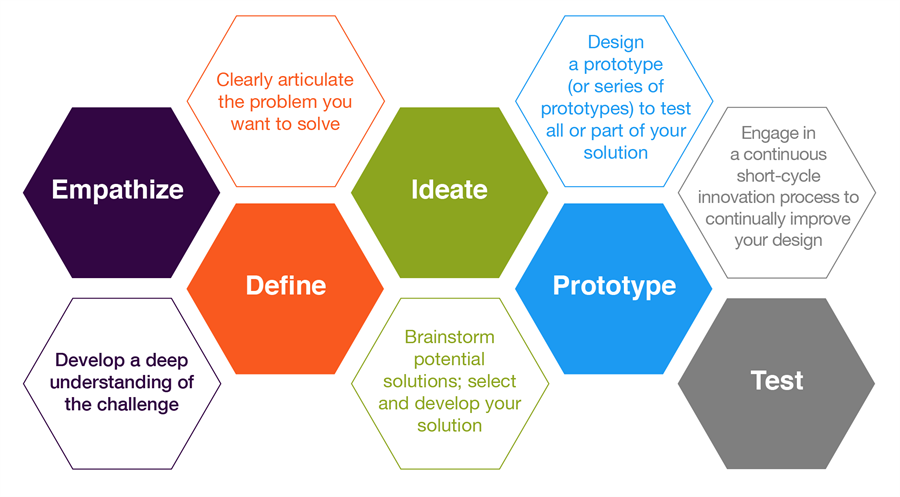
Reflecting on our past 2 years in the cohort model, what I (and I believe the school’s we’ve supported) have loved most are the empathy interviews. If you want to know how your stakeholders really feel observe them and talk to them. These interviews have been so powerful in uncovering trends which might not have been noticed if we used a quick poll or survey to gather our data. What has not been my favorite part of our process is how late in the year our groups have started. We start school in August but typically did not get the cohort process started until September. This late start gave a time crunch to move through the phases and participate fully in the cycle before testing season starts in April.
After reviewing our current setup, my colleagues and I were able to jump start the process by having a kick-off meeting in July during teacher pre-planning. It was a 1.5 hour meeting where our superintendent and associate superintendent were able to share the importance of this work and how it connects the dots to so many things in our district. We created common language by conceptualizing each of our Personalized Learning principles (Mastery Based, Student Ownership, Authentic Experiences, Technology Enhance, and Equity by Design). Finally, we went over the empathy phase of Design Thinking and next steps for groups.
Overall this meeting achieved it’s intended purpose and our teams left with an action plan and steps to take before our first full cohort meeting in September. I’ve known we have support from our superintendent and associate superintendent but was blown away with their words and activities to start our meeting. It was perfect for schools to see how much support they have to take risks and design their vision for education. I also loved the new approach we took to introducing and explaining our Personalized Learning principles. In the past we’ve shared an explanation of each and provided some examples. This year we finally agreed on giving a brief definition and have Allison Zmuda’s work to thank for this. Her brief video gives a great overview that is aligned with our beliefs of Personalized Learning. In addition to the quick definition, we rethought how to share the principles in a way that would create deeper understanding and common language at the same time. After working with Julie Stern I began rethinking how I’ve structured professional learning. Her work centers on #LearningTransfer and around participants (usually from the student lens) making sense of concepts and the relationships between them before being explicitly told what they are. We used the See-Think-Wonder strategy for teachers to look at images representing parts of each principle, discuss what this makes these think the principle means, and then discuss any wonderings they still had. This was a great partner then whole group conversation that went so much better than if we had just told them the definition.
Of course, the day doesn’t go without possible tweaks that could be made. Even though we have what I consider to be successes to the start of the year, as a team we have reflected and next year will make a few adjustments. We will remove some of the fluff or extra videos and activities that aren’t 100% necessary. We began to run out of time and felt rushed at the end of the meeting. Due to extra pieces at the beginning we didn’t get to cover the empathy interview section as thoroughly as possible. I believe schools left with a general idea about the empathy interview process and were happy to have an empathy action planner to complete and guide their work in August and September, but feel we could have done a better job facilitating this part of the meeting. You never know until you try though and it was a learning experience to keep in mind for next year.
We have now been in school for a little over a week, and I’m blown away with the teams’ attentiveness, dedication, and reflective nature. They have each completed their action plan and are in the process of setting up and conducting interviews. (I can’t wait to get a chance to sit in on a few!) We are in a much better place at the start of this year, and I’m excited to see how each school’s ideas develop and grow through this process. I know with the help of my director (Lynn Seay) and colleagues (Alena Zink and John Strang) we will be able to support these teams in accomplishing great things.
For those of you who have already started or are nearing the start of the school year, good luck! I hope you try something new and make time to reflect along the way.


 Finding My Angle
I think this will be a year of “reflection in action” for me and our Liberty teams. Thanks for your leadership as we continue the journey.
LikeLike
I’m excited to be part of your team! Y’all are going to do phenomenal work increasing student voice and advocacy.
LikeLike